Marketing often takes a backseat to daily operations – but in 2026, ignoring it means missing out.Nearly 94% of small businesses planned to increase their marketing spend in 2024, and with the right moves, you don’t need a huge budget to stand out. Whether you’re a roofer, boutique owner, or painter in West Michigan, this guide highlights five realistic strategies to grow your business without burning out.
Get Found First: How to Win in Local Search in 2026
If your business serves a local market – like a Grand Rapids painter or a Kalamazoo roofer – mastering local search is non-negotiable. Google’s latest updates prioritize well-maintained listings, accurate local data, and user engagement. With AI-driven personalization influencing how results are shown, local SEO is evolving fast.
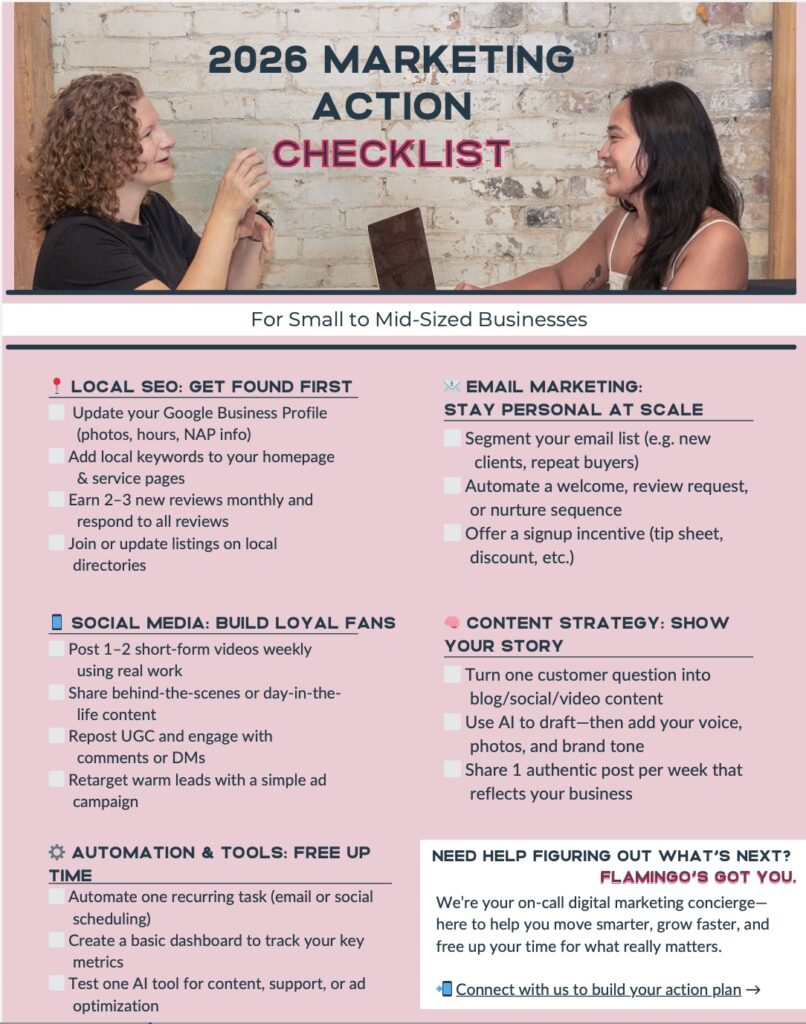
Focus your efforts on:
Optimizing your Google Business Profile with correct NAP info, updated photos, and hours.
Using location-specific keywords and content to improve how search engines connect you to local queries.
Encouraging and responding to reviews – these are increasingly factored into AI-generated search summaries.
Getting listed on local directories and trade associations to boost your digital footprint.
Add local keywords to your homepage and service pages
Set a goal to earn 2-3 new reviews per month
Join or update listings on relevant local directories
Respond to every review (positive or negative) within 48 hours
Build Loyal Fans, Not Just Followers: Social Media That Converts
Social media remains one of the best marketing avenues for small businesses – but the game has changed. The focus in 2026 is clear: prioritize community and visibility over virality. Platforms like Instagram, Facebook, and TikTok are evolving fast with AI tools that help you create content quickly while rewarding authentic, engaging posts with local reach. Sprout Social’s 2024 report confirms that users increasingly favor brands that foster community over those chasing trends.
The sweet spot? Short-form videos, behind-the-scenes clips, and user-generated content (UGC). Think a local painter sharing a 30-second time-lapse or a bakery showing off a frosting technique. Invite your happy customers to tag you and reshare their posts – real stories win trust.
Think connection over perfection. The businesses showing up and engaging daily are the ones building long-term brand loyalty.
To Do List:
Create 1–2 short-form videos each week using real customer work
Share behind-the-scenes or day-in-the-life content weekly
Encourage customers to tag you and repost their UGC
Run a low-budget ad campaign to retarget your warm leads
Set aside 15 minutes daily to engage with comments and DMs
Stay Personal at Scale: How Email Marketing Still Wins
Luckily, automation tools can help. Set up triggers like birthday discounts or follow-up messages without lifting a finger. Just remember – add a personal touch: use their name, location, or reference their last interaction. Keep it casual and helpful, not robotic.
The goal is for your emails to feel like a helpful nudge from a neighbor, not spam. When done right, email is not only great for nurturing leads – it’s also a powerful driver of repeat business.
And your list? That’s an asset you own. Promote signups with a freebie or discount – because unlike social media, no algorithm can take it from you.
To Do List:
Segment your email list and personalize your messages
Automate one new nurture or follow-up sequence
Promote your email list with an incentive to grow subscribers
Your Story Sells: Creating Authentic Content in the Age of AI
Content creation has changed – fast. Generative AI tools can now help you draft blogs, brainstorm ideas, and generate social captions in seconds. HubSpot’s 2024 State of Marketing report shows that over 60% of marketers are using AI to support content creation while balancing it with authenticity. But with this surge in automation, audiences are tuning in to what feels real. Templated content gets ignored. Your voice gets remembered.
Use AI to speed up drafting, but infuse it with your personality, real stories, and photos. That blend builds trust.
And don’t overcomplicate your content strategy. One great idea can stretch far: a common customer question becomes a blog, a short video, and a social post. For example, a landscaper might show a yard transformation with before-and-after photos, write a quick seasonal tip blog, and create a video walkthrough – all from one project.
Share what matters – how you help people, what problems you solve, and what your clients are saying. That’s what builds trust. Add in smart SEO practices, and your content can keep delivering long after it’s posted.
AI is a boost, not a replacement. Your story is still the reason people choose you.
To Do List:
Repurpose one customer question into 3 content formats
Use AI to generate first drafts, but add your voice and examples
Commit to one authentic content post per week that reflects your brand
Free Up Time and Get Clarity: Automation for Busy Owners
When you wear a million hats in your business, time is your most precious resource. This is where digital tools and automation come in – to take repetitive tasks off your plate and provide insights that used to require a whole analytics department.
Consider some examples of working smarter:
Scheduling and Automation: Use social media schedulers to batch your posts in advance, or email automation to send out drip campaigns and follow-ups without manual effort.
Customer Relationship Management (CRM): An entry-level CRM system will organize your customer contacts, track interactions, and even remind you when to follow up.
Analytics and Dashboards: Tools like Google Analytics, social media insights, and ad platform analytics show you what’s happening. Better yet, you can link data into one dashboard to see all your key metrics in one place.
AI for Efficiency: From AI writing assistants to tools that automatically adjust your ad bids, artificial intelligence is a small business’s new best friend. According to McKinsey, 40% of businesses using AI have already seen significant cost savings or revenue increases from adopting automation.
If you’re still manually juggling email follow-ups or guessing what’s working in your marketing, this is your sign to simplify. Small businesses in 2025 have an expanding toolkit to do just that. A few smart tools can free up your time and sharpen your strategy. You’ll look more polished, move faster, and stay competitive – even without a big team.
To Do List:
Automate one repetitive task using a scheduling or email tool
Set up a simple dashboard to track key marketing data
Choose one AI tool to test for writing, customer service, or ad optimization
Putting It All Together (And Getting Help If You Need It)
It’s clear that successful small business marketing today isn’t about out-spending the big players – it’s about out-thinking them with smart, customer-focused strategies. By honing your local SEO, engaging genuinely on social media, nurturing leads through email, sharing valuable content, and leveraging automation tools, you can create a marketing engine that punches well above its weight.
Feeling inspired but unsure where to start? You’re not alone. Every growth story begins with a decision to take that first step – and you’re already there just by reading this. That next step? Let’s talk about where your business is headed and how to use these trends to fuel your growth.
Connect with Flamingo Consulting to chat through what’s working, what’s not, and what could move the needle. We’ll help you make sense of what matters most and build a clear, customized action plan – without the stress. It’s time to get focused, get confident, and get moving. Want a simple way to start? Download our free checklist that recaps these key trends and gives you a quick-reference guide to take action – on your time.
This morning, before I’d even had my first sip of coffee, I opened my inbox and got smacked in the face by two dozen Black Friday emails – each one louder than the last.
Random stores I’m 99% sure I never intentionally subscribed to.
It’s still a week before the actual Black Friday – the Friday after Thanksgiving, the “official” kickoff to holiday shopping – and everyone is already shouting into inboxes like the doors just opened at Best Buy and they were handing out free TVs.
Instead of rolling my eyes and hitting delete, it made me stop and think:
What does this tell us about the state of marketing – and the state of business – right now?
A lot, actually.
Businesses Are Fighting Not to Get Buried on Actual Black Friday
Let’s be honest: If you send your Black Friday deal on Black Friday, you’re basically throwing it into the void.
Everyone is sending. Everyone is posting. Everyone is discounting. Everyone is desperate for attention at the exact same time.
So what’s happening now? Businesses are shifting earlier – a week or more – because:
They don’t want to get lost in the Black Friday inbox apocalypse.
They want to catch early shoppers before they mentally check out.
They want to “claim the mindshare” before competitors pile in.
They’re hoping people aren’t burned out yet.
It’s not an accident. It’s a strategy shift.
Inbox algorithms favor early senders, and timing now matters as much as the offer itself. Customers who plan ahead buy earlier. Retail psychology has shifted toward spreading out purchases.
But that’s only half of the picture.
The Earlier Blast Is Also a Sign of Economic Strain
This part is less fun but very real:
Businesses are feeling the pressure of lower spending and tighter budgets. Consumers are spreading out holiday purchases. Families are buying differently (more caution, less impulse). Q4 performance is carrying more weight because earlier quarters have been unpredictable.
So what do businesses do when they feel that squeeze?
They start Black Friday… earlier.
Not because they love the chaos. Not because it’s trendy. But because they need to secure revenue now, not later.
This early push reflects an economy where:
people are pacing their spending
businesses can’t wait until the “official” day
holiday budgets are already stretched thin
and everyone’s trying to get ahead of the slump
It’s survival strategy disguised as holiday cheer.
Black Friday Is No Longer a Day – It’s a Season
This is the big takeaway:
Black Friday isn’t a single day anymore. It’s a marketing season.
And if you’re planning your Black Friday deal in mid-November?
You’re already late.
A properly executed Black Friday strategy should have been:
finalized in September
designed and scheduled in October
automated and ready to go by November 1st
By the time you’re asking, “Did I miss the Black Friday wave?”…the wave already hit, receded, and washed half the inboxes clean.
This isn’t a judgment – it’s simply how fast and crowded the marketing world has become. It’s the reality of how fast and crowded the marketing world has become, and why intentional planning and early execution matter more than ever for visibility, engagement, and ROI.
The Good News: This Year Might Feel Chaotic, But Next Year Doesn’t Have To
If this week gave you a tiny panic spike… you’re not alone. And honestly? It makes sense. Most businesses scramble their way through Black Friday every single year – not because they’re disorganized, but because the entire season has shifted faster than anyone could adjust.
But here’s the truth: A stressful Black Friday isn’t inevitable. It’s preventable.
With the right marketing partner – whether that’s a strategist, coach, or agency – you can walk into November next year already:
planned,
scheduled,
automated,
and confidently ahead of the inbox chaos.
A strong advocate helps you:
map your Black Friday offers months in advance
spot economic and consumer shifts early
build campaigns that warm your audience before November even hits
automate everything so you’re not frantically designing graphics at midnight
protect your brand from getting buried in the noise
make your promotions feel strategic, not rushed
Imagine entering next holiday season knowing your Black Friday strategy is done – dialed in, optimized, and already working for you…rather than something you’re scrambling to pull together between client calls, staff meetings, and last-minute emergencies.
That’s the Flamingo difference: We help you stay ahead of the season instead of drowning in it.
And if you’re looking at your inbox today thinking, “Okay… next year needs to look different”?
Let’s talk about it now, while everything is still fresh enough to fix. No pressure. No judgment. Just clarity and a plan.
Let’s get ahead of 2026 now – so next year’s big promos (yes, including Black Friday) don’t turn into a sprint.
Why “Scrappy” is the New Smart in West Michigan If it feels like the marketing world is changing under your feet, you’re not wrong.
Budgets are tighter. Agencies are closing. Attention spans are shorter. And AI? It’s rewriting the rules by the week.
If you’re a small or mid-sized business in West Michigan, you’re probably feeling it all – the pressure to do more with less, to keep up with technology you don’t fully trust yet, and to somehow still connect with your customers in a way that feels real.
The landscape is shifting – but here’s the good news: you don’t need to panic, you just need to pivot.
The Local Reality: Change Is Hitting Home
The shifts we’re seeing across West Michigan aren’t just business headlines – they’re human stories. When agencies close, we all feel it. At Flamingo, our collaboration over competition philosophy means we see these moments not as wins or losses, but as reflections of how connected our creative community really is. We care deeply about the people, families, and teams affected by these changes – and the businesses navigating sudden uncertainty. We’re committed to helping our community rebuild and grow stronger together.
For many small businesses, that agency wasn’t just a vendor; it was a partner, a friend, a trusted voice. Losing that kind of relationship leaves a hole – and it’s okay if you’re feeling a bit unmoored right now.
At the same time, costs are rising, ad performance feels unpredictable, and marketing suddenly feels more complicated than ever. If you’re trying to find your footing again, you’re not behind – you’re right on time for the next evolution of marketing built for this moment.
The Problem: Marketing Got Complicated (and Expensive)
The economic context is real—but also an opportunity. While inflation, staffing challenges, and ad costs continue to pressure small businesses, those who adapt fastest to these conditions often come out ahead.
For years, big strategies and bigger budgets ruled the game. But the truth is, most small businesses don’t have that luxury – not now, not with inflation, staffing challenges, and rising ad costs.
Across industries, marketing budgets have stalled around 7–8% of company revenue, and that number isn’t climbing anytime soon. Here in West Michigan, we’ve seen the ripple effect: longtime agencies downsizing or shutting their doors, smaller businesses losing their marketing support overnight, and owners left scrambling to figure out what comes next.
The ripple effect doesn’t stop with agencies – it’s a reflection of the entire marketplace. Consumer spending has slowed across several sectors as people pull back on discretionary purchases, influenced by lingering inflation, previously high interest rates, and ongoing economic uncertainty. That means fewer impulse buys, longer decision cycles, and tighter budgets for your customers – and by extension, for your business. It’s not that your marketing isn’t working; it’s that the ground beneath it has shifted.
If that’s you – we see you. You’re doing everything right. The game just changed.
The Shift: From Big Budgets to Scrappy Strategies
The old marketing playbook – long-term campaigns, expensive retainers, and “set-it-and-forget-it” strategies – doesn’t work in this new economy.
Today, the most successful businesses are the scrappy ones:
They move faster so they can react quickly and waste less budget on outdated tactics.
They test more and learn faster.
They use new tools – like AI – not to replace their voice, but to amplify it.
AI is changing how marketing gets done, but not why it gets done. The goal is still the same: connect with people in a meaningful way. The difference is that now, even small businesses can use technology that once belonged only to corporate giants.
AI can help you write smarter, target better, and save hours – if you stay in control of the message. Use it to get clearer, quicker, and more creative, not colder or more robotic. The future belongs to the businesses that blend tech efficiency with human connection.
What We’re Hearing Across West Michigan
With these shifts, we’re seeing some pretty profound shifts:
Businesses are pausing ad spend and doubling down on word-of-mouth.
Local service-based businesses – salons, gyms, wellness centers, trades – are focusing on retention over reach.
Retailers and restaurants are cutting costs by going all-in on community engagement – pop-ups, collaborations, and local events.
Here’s what that means for you as a business owner: the trend is clear – local connection is the new marketing currency.
What’s Working Now
As we head into 2026, every strategy needs to earn its keep. When we need to stretch what we can spend on marketing and still get ROI, consider this:
Plan smaller, pivot faster. Think in 90-day sprints instead of year-long strategies so you can adapt quickly and reduce wasted spend.
Build flexible teams. Mix in freelancers, fractional marketers, or boutique agencies (hey 👋) who can scale with your needs and keep quality high without fixed overhead.
Focus on local. 87% of Michigan consumers use Google to find nearby businesses – and 76% visit the same day. Be findable, and be review-worthy.
Let AI do the heavy lifting – not the talking. Automate tasks, not your voice. AI should enhance your brand’s story, not write it for you.
Get personal again. Consumers are craving authenticity. Show your team, your story, your values – it’s your biggest competitive edge.
The Opportunity: This Is Your Reset Moment
When the landscape changes, the playing field levels.
This is your moment to pause, re-evaluate, and rebuild a marketing plan that fits the business you are now – not the one you were pre-pandemic or pre-AI.
In times like these, the businesses that survive aren’t always the biggest – they’re the most adaptable. When consumer behavior is unpredictable, a flexible, data-driven marketing plan is your best protection.
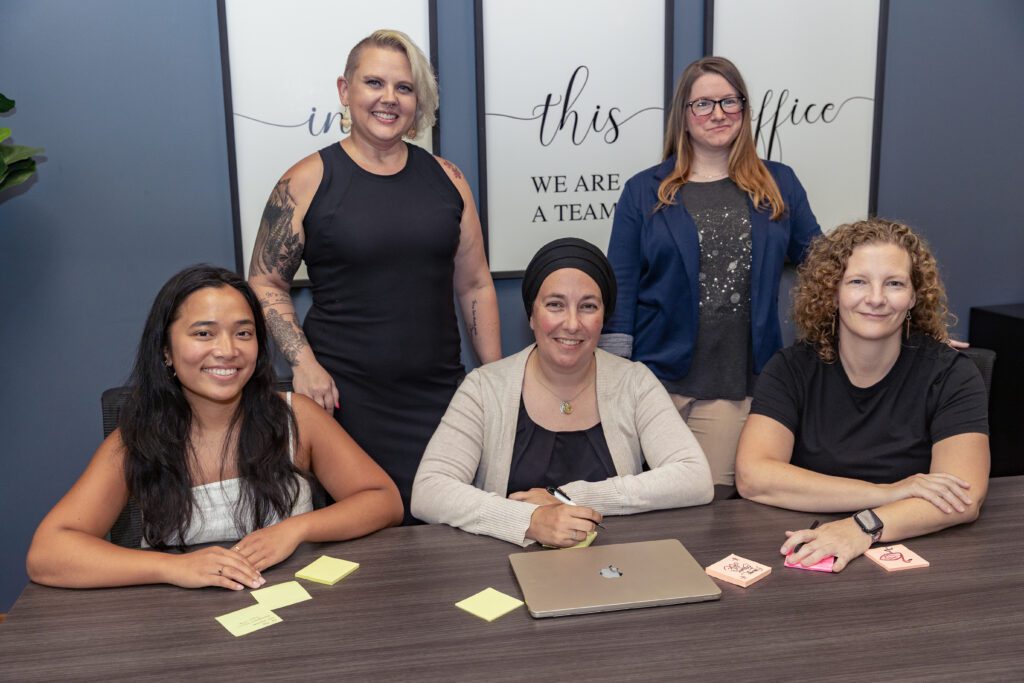
At Flamingo, we’ve spent the last decade helping businesses navigate moments just like this. We’re not scared of change – we thrive in it. We act as your digital marketing concierge: your steady guide, your sounding board, and your strategy partner when everything else feels like chaos. When we help each other adapt, the entire West Michigan business community wins.
If You’ve Lost Your Agency (or Outgrown It)
If your agency closed or shifted directions, it’s okay to feel hesitant about starting over. We’ve met with a lot of business owners lately who feel like they’re back at square one – whether because they’re shifting vendors, changing staffing, or even just refocusing on marketing as their business feels sluggish. They’re wondering where their files live, what happens to their website, or how to keep their marketing from stalling out.
You don’t need to navigate that alone. We can help you pick up the pieces, protect what’s yours, and build a plan that fits the season you’re in now.
Your Next Step
Whether you need to rebuild your marketing from scratch or just want a second opinion on what’s next, we’re here to help – judgment-free, jargon-free, and right here in West Michigan.
🍵 Let’s grab coffee and talk about what’s next for your business. When we meet, we’ll take a look at your current marketing assets, review where the gaps are, and identify quick wins you can act on right away – whether you work with us or not. Because you don’t have to do this part alone – not anymore.
Let’s talk about stage fright. No, not the kind when you get when you sing karaoke, or when you’re part of the community theatre production of Grease (though we thoroughly support and endorse both of those objectives).
Did you know marketing stage fright is a thing? We’ve all been there. We’ve got an email newsletter to send, or a social post to write…and it’s all written, and you can’t force yourself to push send. You edit round after round of drafts, ask your closest five friends to weigh in, and then you set it aside for the “right moment.” We’ve been there too – as a matter of fact, this post is being written because our writer is suffering from it right now herself! But the truth is: you need to market your business, and that comes from actually showing up in those spaces, even though it is scary.
How do you make it happen so that you’re posting, publishing, and creating consistently? We’ve developed a few tips over the years.
Outsource and disassociate from it.
It’s what we do here at Flamingo, and we’re good at it. But not in the ways you might think. We can see your brand from a higher level. It’s not our heart and soul and passion, so we can view it more objectively and – quite honestly sometimes – with less caring. Our big secret: Alicia almost never writes her own content for this reason.
Can’t think of getting yourself out of the creative role? Send your content to someone you know and trust, whether that’s us or your bestie, and give them permission to hit the big scary publish button!
Batch tasks
We’ve found that writing and creative work entails a completely different type of brain function than the administrative side of scheduling and publishing. By putting those types of tasks together, not only will you be more efficient, but you won’t get as stuck in marketing overthink because you won’t be in the same frame of mind when you’re publishing 10 posts at once!
Understand that you’re only the most important person to you. (And maybe your mom).
We love you and your business so much, but to be honest – we’re not eagerly waiting on our phones waiting for you to publish your next thought. People are busy. No matter how much you struggle with a piece of content, know that only a fraction of the people who interact with your audience are ever going to see it! It varies widely by industry but the average open rate of an email campaign is under 20%. That means for every 200 people you send to, only 40 will actually even open it. Not to mention, an even smaller number of them will actually comprehend, click, or take action. It’s why it’s been said that you have to tell someone something at least 7 times before they actually understand it. The social media algorithm operates the same way. That’s why we encourage the use of ads to help you reach even more of your audience.
Imagine you’re on that big stage again, belting out the big tune. Now envision that only 20% of the auditorium is full. It’s a lot less scary right?
So, because only a few people are going to see it, that means you only have to do a little bit of work, right? Bad news: We’re afraid not. Due to technological reasons, if you want your content to be seen by even that 20% of people you have to keep publishing consistently. But the good news is that your audience is less perceptive than you think. Don’t be afraid to be messy, or publish things that are less than perfect. The more you continue to get yourself out there, the easier it will be, and you’ll be able to reap more of the rewards of your efforts.
Still having fears about hitting the red button? We’d love to help, whether that’s from strategic coaching or taking on some of those tasks for you. Hit the button below to schedule a chat with our team!
The Internet has revolutionized the way we consume content. We pay an arguably low price for access to more than we’ll ever be able to watch, listen to, or read in our lifetime. But how are those companies able to stay afloat when we’re no longer paying hefty prices for reading material as we did back in the days of cable TV? The answer is advertising.
Back in the day, advertising meant business people had to pay for things like newspaper advertisements, radio spots, and billboards. While we’ll argue that it’s definitely easier for a little guy to compete thanks to strategies like social media, we have to be the bearer of bad news: you still need to advertise, and you need to pay for it.
The world has transformed from a 1-to-many advertising space to a 1-1 advertising space. That means, our customers are smarter and have way more choices than you and I may have had growing up. Hulu with ads, or Netflix with none? Facebook or Tik-Tok? Google or Bing? The good news is that there are more ways than ever to reach people. The bad news is, you can’t reach everyone. You need to be much more strategic about understanding what your customers like to do – and find them in those areas. Is your product perfect for teens? You better be on Snapchat and TikTok. But if you’re reaching a 50+ crowd, chances are you’ll still want to be on Facebook – or even regular television!
Do you really have to advertise? Aren’t free strategies such as posting on Facebook and having a SEO-optimized website enough? That depends. If you’re running an incredibly niche business or have more than enough customers than you can handle right now – then perhaps. But most of our clients are constantly peeking around their shoulder at the competition, and spending some money on Facebook, Google, or YouTube ads might be worth it to put a little breathing space between you and them.
Our ask? Be patient, and be realistic. Digital ad platforms such as Facebook and Google allow you to spend as little as $1/day. That’s incredibly alluring to many small business owners – however, you can’t expect to reach millions with that limited of an investment. In general, we like to use that budget level to try out campaigns for a limited timeframe, to make sure that our ad objectives are in line with the types of people we want to reach. Once you get going, we’d recommend you plan to spend at least $5/day for your ad for you to notice any impact on your bottom line.
One of the questions we’re frequently asked is: “Should I boost posts?” Our answer again: that depends. What is your goal? Do you want to reach more people? Do you want to promote a special event or a page on your website? If your post is timely and relevant and you have a demographic in mind you’d like to reach, then boost away! Just note it’s not recommended to boost the same post more than seven days consecutively. You run the risk of making your audience bored or tired of your content.
What if you don’t know where to start, or have a limited budget to work with? Reach out to us, and we can help you devise a marketing strategy that helps you get the most engagement for your dollar. Schedule a chat with us today!






Recent Comments