A good CRM is one of the smartest investments a growing business can make. It keeps leads from falling through the cracks, automates follow-up, organizes customer information, reminds your team what needs to happen next, and takes a mountain of repetitive tasks off your plate.
That’s a win.
Think about everything that went into earning that lead in the first place.
Maybe they found you through months of SEO work. Maybe they clicked on a Google Ad. Maybe they saw one of your social media posts. Maybe a past client trusted you enough to recommend your business to a friend. However they got there, someone invested time, money, creativity, and effort to get that person to finally raise their hand and say, “I’m interested.”
That’s not a small moment.
The last thing you want is to lose that opportunity because someone forgot to make a phone call, respond to an inquiry, or send a follow-up email.
That’s exactly why we love CRMs.
They’re one of the best tools available to protect the marketing investment you’ve already made.
But here’s what we’ve been noticing lately.
Somewhere along the way, businesses started assuming that once the automation works, the customer experience is finished.
It’s not.
Automation Isn’t the Same Thing as Marketing
Most CRM specialists are incredibly good at what they do.
They build workflows. They connect software. They create pipelines. They make sure every trigger, notification, reminder, and automation happens exactly when it’s supposed to.
That’s their job.
But marketing is a different job entirely.
Marketing asks different questions.
Does this email sound like us?
Does this form inspire confidence?
Does this text message feel warm and human?
Does every touchpoint reinforce the brand we’ve worked so hard to build?
Those aren’t workflow questions.
They’re customer experience questions.
And that’s where businesses unintentionally create a gap.
Your Customer Doesn’t Know Where Your Website Ends and Your CRM Begins
Your customer has absolutely no idea what software you’re using.
They don’t know your reminder came from HighLevel.
They don’t know your intake form came from HubSpot.
They don’t know your invoice was generated by another platform.
They don’t know who built the automation.
And honestly…
They don’t care.
What they experience is your business.
To them, every email, every reminder, every confirmation page, every invoice, every text message, every intake form, and every client portal is simply another interaction with your company.
If one piece feels polished and another feels robotic…
They don’t blame the software.
They blame the business.
Here’s Where It Gets Expensive
One of the biggest misconceptions we see is that businesses think their CRM is managing existing customers.
In reality…
Most CRM automations happen long before someone becomes a loyal customer.
Think about when your workflows actually start.
Someone fills out your contact form.
Requests a quote.
Books an estimate.
Schedules a consultation.
Downloads a guide.
Maybe they’ve exchanged one email with your team.
That’s it.
They haven’t bought yet.
They haven’t experienced your service.
They haven’t told their friends about you.
They’re not loyal.
They’re evaluating you.
Every single interaction is helping them answer one question:
“Do I still feel confident choosing this company?”
That’s a much bigger responsibility than simply sending reminders.
According to PwC’s 2025 Customer Experience Survey, nearly one in three consumers have stopped buying from a company because of a poor customer experience. Even more interesting, 89% of business executives believe they’re creating customer loyalty, while only 39% of consumers agree.
That’s an incredible disconnect.
We think we’re building confidence.
Our customers don’t always agree.
And confidence matters because it comes before trust.
Trust comes before a sale.
Sales come before loyalty.
If your CRM is damaging confidence…
It never gets the chance to build loyalty.
Every Touchpoint Is Either Building Confidence… or Chipping Away at It
(this will be in graphics so it doesn’t take up so much real estate)
A Confirmation Email
Most businesses send something like this:
Thanks for submitting your request. Someone from our team will contact you shortly.
Is it wrong?
Not at all.
Is it memorable?
Not really.
Now imagine this instead:
Hey! We got your request and one of our team members is already taking a look. You’ll hear from a real human within one business day. In the meantime, here’s what happens next…
The information didn’t change.
The feeling did.
One sounds like software.
The other sounds like a company that’s genuinely excited to help.
Appointment Reminders
Most reminder texts are perfectly functional.
Reminder: Appointment tomorrow at 10:00 AM.
Done.
Now compare it to this:
Just a quick reminder—we’re looking forward to seeing you tomorrow at 10:00! Need to reschedule? No worries. Use the link below or give us a call. We’ll make it easy.
It’s still automated.
It just doesn’t feel automated.
Your Contact Form
This one hurts.
A customer spends five minutes on a beautifully branded website.
They’re impressed.
They click “Contact Us.”
…and suddenly they land on a generic white form with gray buttons, default fonts, no logo, and a giant button that says Submit.
Technically?
Nothing is broken.
Emotionally?
Everything just got a little less exciting.
Imagine instead a form that carries your branding forward with your logo, your colors, a friendly introduction, a quick explanation of what to expect, and language that actually sounds like your business.
Same form.
Completely different experience.
The Follow-Up Text
We’ve all received them.
Just following up.
Or…
Hi.
Those messages immediately feel automated because they are.
Now imagine receiving this:
Hey Sarah! Just wanted to make sure our last email didn’t get buried. No pressure at all—if you’ve got questions, we’re happy to help.
It still came from your CRM.
But now it sounds like a human.
The Client Portal
This one might be our favorite.
You’ve invested thousands of dollars into your website.
Beautiful branding.
Professional photography.
Thoughtful messaging.
Everything feels intentional.
Then your customer logs into your portal…
…and suddenly they’re staring at default blue buttons, generic fonts, robotic emails, and pages that look like they belong to someone else.
It’s like checking into a gorgeous boutique hotel only to be escorted into a fluorescent-lit storage room.
Nothing is technically broken.
But the confidence you spent months building just took a hit.
Here’s a Challenge
Pretend you’re a customer.
Fill out your own contact form.
Book an appointment.
Read every automated email.
Open your client portal.
Pay an invoice.
Cancel an appointment.
Click every button.
Then ask yourself one simple question:
If I didn’t own this company…would this experience make me more confident or less?
If you cringed even once while going through your own customer journey…
You’ve probably found something worth improving.
Our Favorite Seat at the Table
One of our favorite things to do at Flamingo isn’t designing websites or writing ad campaigns.
It’s walking through a customer’s journey with fresh eyes.
Not because we’re looking for mistakes.
We’re looking for moments.
The moment someone wonders if their request actually went through.
The moment they decide whether your business feels organized.
The moment they feel cared for.
The moment they think,
“Yep…I picked the right company.”
Those moments are marketing, too.
That’s why we call ourselves a digital marketing concierge.
A concierge doesn’t just point you toward the right destination.
They make sure every step of the journey feels intentional.
Every touchpoint should reassure your customer that they’re in the right place.
Every email should sound like your business.
Every reminder should feel like it came from a real person.
Every form should reinforce the confidence your marketing worked so hard to earn.
Because marketing doesn’t end when someone clicks Contact Us.
In many ways…
That’s where some of the most important marketing begins.
A CRM makes your business more efficient.
But thoughtful marketing makes your CRM feel human.
And when those two work together, you’re not just protecting leads.
You’re protecting the trust that turns curious prospects into confident customers—and confident customers into loyal advocates.
One final recommendation
If this is going on your website, I would not end with a hard sales CTA.
Instead, end with something that feels like an invitation—very concierge, very Alicia:
Not sure what your customers experience after they click “Contact Us?”
Grab a cup of coffee with a friend who’s never been down the rabbit hole of your experience before (or pretend you’re a first-time customer), and walk through your own process. You might be surprised by what you find.
And if you’d like a second set of eyes, we’d be happy to walk the journey with you. Sometimes the smallest moments make the biggest difference.
wondering if your marketing team forgot to turn something on
Honestly? You’re not alone.
This is one of the most common things business owners do after launching Google Ads — especially local service businesses and growing companies here in West Michigan trying to figure out whether their ad spend is actually working.
It’s also one of the fastest ways to completely misunderstand how Google Ads actually work.
Because Google Ads are not static billboards.
And ironically? The more you search for your own ads, the harder they can actually become to find.
Yep. Really.
Why You Don’t Always See Your Own Ads
A lot of people assume:
“If I’m paying for Google Ads, my ad should show every single time I search.”
That would make sense.
But that’s not actually how Google Ads work.
Google is constantly adjusting ad delivery based on things like:
location
search intent
competition
budget pacing
device type
search history
audience behavior
time of day
and overall relevance
Every time someone searches, Google runs a live auction to decide:
which ads show
in what order
and for which users
Which means: Your ad may appear sometimes… …and not others.
That’s normal.
Why Searching for Your Own Ads Can Hurt Performance
This is the part most agencies don’t explain very well.
Google watches user behavior. Closely.
So if you repeatedly search for your own ads and DON’T click them, Google may start interpreting that behavior as:
“This ad may not be highly relevant for this search.”
Over time, that can actually reduce the likelihood of you seeing your own ads.
And if you DO keep clicking your own ads? You may literally be charging yourself for quality control.
This is why experienced marketing teams don’t rely on manually Googling ads to determine performance.
We rely on:
conversion tracking
backend analytics
call tracking
lead quality
landing page behavior
cost per conversion
and actual business results
Because seeing an ad is not the goal. Generating qualified leads is.
Clicks Don’t Automatically Mean Your Ads Are Working
This is where a LOT of businesses get frustrated, because a campaign can generate:
tons of clicks
lots of traffic
and a beautiful-looking report…
…and still completely fail at generating revenue.
Why? Because traffic is only one piece of the equation.
We’ve seen businesses spend thousands sending traffic to:
broken forms
outdated websites
pages with no clear call-to-action
slow mobile experiences
or contact pages nobody ever responds to
We’ve seen businesses paying for leads while:
calls go unanswered
inquiries sit for days
sales teams forget to follow up
or the actual offer simply isn’t compelling enough to convert.
At that point? Google Ads usually aren’t the real problem. They’re just exposing the bottleneck faster.
Because clicks don’t pay your bills. Conversions do.
Google Ads Can’t Fix a Broken Funnel
This is probably the hardest — and most important — conversation we have with businesses.
Google Ads are not magic. They are an amplifier.
If your business already has:
clear messaging
a strong offer
a good customer experience
and a healthy sales process…
Google Ads can accelerate growth very quickly.
But if the foundation is shaky? Ads usually just help you fail faster and more expensively.
That’s why we look beyond the ads themselves. Sometimes the issue isn’t:
targeting
keywords
budget
or ad copy
Sometimes the issue is:
customers getting confused on the website
inconsistent branding
no trust-building content
poor follow-up systems
weak calls-to-action
or a funnel that simply isn’t built to convert.
Google Ads are a funnel filler.
Especially for West Michigan businesses competing in crowded local markets, ads can drive attention quickly — but attention alone doesn’t create revenue. Your business still has to turn that attention into trust and action before the money rolls in.
Feeling Like Your Ads Are Driving Traffic But Not Real Leads?
That’s usually a sign something deeper in the funnel isn’t working the way it should.
Sometimes it’s the ads. Sometimes it’s the landing page. Sometimes it’s the messaging, follow-up, or customer journey after the click.
That’s exactly the kind of thing we help businesses figure out every day.
You’re not crazy. A lot of businesses come to us after feeling like they’ve been throwing money into a black hole with no clear understanding of what’s actually working.
A lot of agencies manage Google Ads in isolation.
They focus on:
impressions
click volume
ad spend
and surface-level reporting
And technically? That can still produce a report that looks successful.
But business owners don’t usually care about reports. They care about:
qualified leads
booked calls
revenue
growth
and whether the marketing is actually helping the business move forward.
That’s why at Flamingo, we look at the entire customer journey. We care about:
what people searched for
why they clicked
what they experienced after clicking
where they got frustrated
what built trust
and what ultimately convinced them to contact you.
Because more traffic alone is not the goal. The goal is building a marketing system that actually converts, and that starts long before we ever launch an ad. Before campaigns go live, we do extensive upfront Google Ads research into:
keywords
competitors
search intent
audience behavior
geographic targeting
and which searches are actually likely to convert — not just generate traffic.
Then during the first several weeks, we heavily test and optimize the Google Ads campaign itself, including:
keywords
headlines
ad copy
calls-to-action
landing page behavior
and conversion quality.
Because not every keyword is worth chasing. Some are too competitive. Some are too expensive. Some bring in the completely wrong audience. Sometimes the messaging businesses THINK will work best…isn’t what actually converts.
That early testing phase gives us real-world data on:
what people respond to
what’s wasting money
and where the strongest opportunities actually are.
Unlike a lot of agencies, we don’t just launch campaigns and disappear behind automation. Yes, Google’s AI tools are useful. but automation without human strategy is how businesses quietly waste money for months before anyone notices.
That’s why our team consistently reviews:
seasonality trends
rising keyword costs
competitor shifts
emerging search behavior
conversion quality
and changing customer intent.
Good Google Ads management isn’t static. It evolves as the market evolves. We’d rather help fix the leak before turning the faucet on full blast.
The Good News?
When Google Ads are paired with:
strong messaging
strategic targeting
proper landing pages
healthy follow-up systems
conversion tracking
and a well-built customer journey…
They can become one of the fastest and most effective lead generation tools for a business, which is exactly why we love them.
Not because they’re magic, but because when they’re built strategically, they work.
Curious Whether Your Funnel Is Helping or Hurting Your Google Ads?
Sometimes the problem IS the ads. But honestly? More often, the ads are simply exposing the weak point somewhere else in the customer journey.
That’s exactly why we don’t believe in simply launching campaigns and hoping for the best. At Flamingo, we look at the bigger picture:
the ads
the landing pages
the messaging
the follow-up
the customer experience
and the full path from click to conversion.
Because good marketing shouldn’t feel like lighting money on fire and hoping for the best. It should generate growth.
And if your Google Ads feel expensive, inconsistent, confusing, or frustrating? There’s a very good chance the issue goes deeper than the campaign itself.
That’s the kind of thing we help businesses across West Michigan figure out every single day.
And honestly? Sometimes a few strategic changes outside the ads themselves can completely change campaign performance.
Not Sure If Your Google Ads Problem Is Actually an Ads Problem?
Sometimes the campaign IS the issue.
But more often? The ads are exposing:
weak landing pages
confusing messaging
broken conversion paths
poor follow-up systems
or gaps in the customer experience that are quietly hurting results.
At Flamingo, we don’t just look at the ad account. We look at the entire system, because marketing should feel intentional. Not confusing. Not fragmented. And definitely not like throwing money into the void hoping something sticks.
In the digital world, Big Tech platforms like Google and Meta provide the sandbox that agencies like Flamingo play in. Sadly, not only do they control the entire playground, but they write the rules – and those can change in a moment’s notice.
The Flamingo team prides ourselves on being expert navigators of these platforms. You may think we sometimes have superhuman skills, but the truth is, there are a vast number of times that we have to surrender to the global infrastructure as well. Today, we thought we’d give you a glimpse behind the curtain, showing you where our influence ends and where our expertise in managing the uncontrollable begins.
Things We Cannot Control (with examples from real Flamingo clients):
I updated my website a few minutes ago – why am I not seeing it yet? Am I doing something wrong?
When you or I hit ‘save’ and ‘publish’ on whatever website content manager you use, it does not instantaneously reflect on every user’s browser at the same time. Believe it or not, your update has to travel around the world, sending data across thousands of global servers. We’re fighting an uphill battle against caching (the process by which your website saves regularly used data – like your homepage – so it can reload it quicker the next time you visit it). If you make an update to a cached item like your homepage, it takes longer because servers have to notice “hmmm! This is different!” instead of simply loading the same thing they’ve loaded a bunch of times before. The truth: We can’t force a server to refresh their cache instantly. It’s like mailing a letter; we can drop it in the box, but we can’t make the mail truck drive faster.
I went viral – and not in a good way! I’m being hit with bad reviews on Google from an angry client and their friends and family. Can you help?
Sadly, the internet is a megaphone for the public, and unfortunately, we cannot “delete” a review just because it’s unflattering or even inaccurate. Freedom of speech on third-party platforms such as Google, Yelp, or Facebook is outside our jurisdiction. In general, they have strict policies regarding review removal, usually only stepping in if the content is proven to be fraudulent, spam, or violates their specific terms of service. The truth: We cannot prevent a disgruntled customer or a “troll” from typing a review on a platform we do not control.
I forgot to pay my yearly hosting fee, and now my website has disappeared! What can I do?
Businesses change all the time, and we don’t want you to have to pay for a site that no longer meets your needs. That’s why we don’t autopay renewals for hosting and domains – we don’t want to trap you into paying for something you aren’t using anymore. Yearly renewals provide us the chance to check in and make sure you’re still happy with your site.
Think of Flamingo as your property manager – who you can come to with questions when something breaks, and who reminds you to stay on top of keeping your digital home up-to-date. But If you don’t pay your rent, and don’t respond to your property manager with a reason why you’re behind, do you get to stay in your apartment? Probably not. The truth: we don’t own the “land” your website sits on; we just manage the house. If the hosting provider or domain registrar doesn’t get paid, they pull the plug.
Why am I not ranked #1 on Google for (insert keyword)? Didn’t I pay you for SEO services?
Google changes its algorithm thousands of times a year. It is a “black box” powered by complex AI and machine learning that considers over 200 ranking factors—from your site’s mobile responsiveness to the quality of your backlinks—and it updates these criteria constantly.
Because Google’s ultimate goal is to provide the best user experience, they never give anyone a “cheat code” to the top. No matter how much we optimize, we are all operating in a landscape where the rules of the game can change overnight. The truth: No one—not even the best agency—has a “red phone” to Google HQ to guarantee the #1 spot overnight.
I’m locked out of my (email, Meta, website) account! Can you help me get in?
If it’s your website, and we host it, the answer is a resounding “YES!” we can help you recover your access. However, if it’s a platform we don’t control – it’s a little more complicated. We’ve seen accounts get locked for the weirdest, most random reasons. We’re not immune to it either – we’ve even gotten locked out of our own accounts a few times!
If you are locked out of your Meta account, and we have been given Business Manager access, chances are that we will still have access and can post things on your behalf even if you are locked out. But if it’s another third-party platform, we may not have any more luck than you.
We know digital marketing is supposed to be instantaneous, but our biggest advice to you is: WAIT. Most of the times, the lock is a temporary, an accidental security measure and you can resolve it by not frantically trying to log in a zillion times. Go catch up on the Pitt, take a walk, or do some non-marketing related work for a while. The truth: If Meta or Google flags an account for “suspicious activity” or a forgotten password, we are subject to their automated support bots just like everyone else. We don’t have “Master Keys” to Big Tech’s security systems.
So…what CAN you control?
While the giants of Big Tech might set the boundaries, we are far from being solely at their mercy. Our value lies in mastering the variables we can influence to build a resilient, high-performing presence for your brand. By focusing our energy on technical precision, strategic backups, and proactive communication, we turn the unpredictable nature of the internet into a manageable—and winnable—game.
Engineering for Speed: We can’t control the internet speed, but we can control the weight of your site. We select high-performance systems (usually WordPress) and plugins, and we optimize media wherever possible, so that when the server does load, it does so at lightning speed. Keeping everything updated and up-to-date and free of malware is the easiest way to keep your site fast!
Reputation Management: We can’t stop reviews, but we can build a fortress around your brand. We can help you set up systems to alert you instantly, and help you draft professional, brand-aligned responses that turn a negative into a positive. Encourage all of your customers – happy or unhappy – to leave you a review. If you’re doing business right, the positive reviewers will naturally outnumber the negative ones.
We Choose the Right Partners: We can’t prevent your site from going down if you don’t pay for it, but we can work with a vendor with a robust (and minimal cost) reinstatement policy. Our hosting provider also takes regular weekly backups, ensuring that if something disappears while you’re in our concierge, we can get you back up and running in no time.
Precision Targeting: We can’t force Google to rank you organically tomorrow, but we can buy your way to the top using strategic Ad Spend and high-intent keywords to ensure you’re seen by the right people. With over 70 combined years of digital experience, our team also knows the SEO strategies that have been foolproof over time, making you less prone to drops due to sudden algorithm changes and updates.
We Emphasize Multi-Channel Strategies: If Facebook goes down, will your business die? We’ve talked here before about how it doesn’t have to. Additionally, we’ve discussed the importance of owning your marketing so that if a platform does go down, or you have to sever a business relationship, your marketing doesn’t disappear overnight.
A Flamingo can’t control which way the wind blows, but it knows exactly how to adjust its wings to stay balanced. Similarly, when Google makes a massive update or a social media platform changes how it displays content, we don’t panic. We pivot. Our job is to stay informed so that if one door closes (like a drop in organic reach), we already have the keys to another door ready for you (like a targeted ad campaign or an email marketing push).
In a world of automated bots and shifting algorithms, you need an advocate who can help you manage Big Tech, not a bunch of empty promises from someone who tells you they can control it. Schedule a discovery call with us today – we’d love to add you to our flock of happy customers!
If you left your agency tomorrow, could you take everything with you?
Imagine you decide a business relationship with your marketing agency is no longer the right fit.
You give proper notice. You follow the contract. You pay your final invoices.
Your domain still exists, but now you can’t access your site, your files, or your data. Ads stop running. Social accounts are locked.
And the next day, your website is shut down.
You didn’t do anything wrong. But you’ve lost access to the marketing your business depends on.
This isn’t about bad agencies or dramatic breakups. It’s about what happens after obligations are met and whether your marketing assets actually belong to you.
If you want to avoid ever being in that position, the next step is understanding where ownership commonly breaks down and how to spot it early.
Ownership vs. Access (The Part Most People Miss)
Owning your marketing doesn’t mean logging into everything every day. In fact, many smart business owners don’t want that.
Delegating execution is normal. It is often the healthiest choice.
The real question is simple:
If you leave, can you take everything with you—cleanly and without disruption?
If the answer is yes, you’re in a good position. If it’s unclear, that’s where risk lives.
Hosting: Where Your Website Actually Lives
Why it matters: Hosting controls whether your site is online, backed up, and transferable.
Managed hosting isn’t a red flag by itself. Many agencies host sites so they can provide faster fixes, backups, and hands-on support.
The issue isn’t how it’s hosted. It’s what happens when the relationship ends.
Quick self-check:
Is hosting under your business name or the agency’s?
Do you have a copy of your site files and database?
Can the site be turned off when the contract ends?
Contract phrases to pause on:
“Access provided during the term of this agreement”
“Hosting services are proprietary to the agency”
“Upon termination, services will be discontinued”
If transfer isn’t clearly addressed, assume it’s restricted.
How Flamingo approaches hosting: We use managed hosting for speed, security, and support. We don’t trap clients.
If hosting changes, we package and hand off all site files and databases, coordinate with the new provider, and ensure the site works on the other side. Your website is built for your business, not ours.
Website Design: What You Paid For vs. What You Own
Why it gets confusing: Website design and development contracts often bundle together visual design, templates, and technical build work. That can make it unclear whether you own the finished website itself or only have permission to use it.
To be clear, branding assets like logos, colors, and visual identity should belong to you if they were created for your business. This section is specifically about ownership of the live website: the pages, structure, layouts, and underlying build.
Quick self-check:
Can the site move without being rebuilt?
Is ownership explicitly stated?
Does termination remove access?
Contract phrases to review:
“Licensed, not sold”
“Client receives a limited license”
“Design remains the intellectual property of the agency”
How Flamingo builds sites: Sites are created for the client, structured under their business, and transferable if hosting changes. If a client leaves, the website goes with them, cleanly.
Social Media: Access Is Not Ownership
Where things go wrong: Accounts are created under agency emails, and clients are added as admins instead of owners.
What ownership should look like:
You’re the primary owner
You control the login email
You can add or remove admins at will
Contract phrases to review:
“Agency-managed social accounts”
“Access granted during active engagement”
How Flamingo handles social: Accounts are created under the client whenever possible. We work with assigned access, and you can remove us at any time. You hold the keys.
Google Ads: The Asset Most Often Misunderstood
Why it matters: Ads aren’t just creative. They’re data, learnings, and performance history.
Quick self-check:
Can you log into your Google Ads account independently?
Is it under your business email?
Contract phrases to review:
“Agency-owned ad accounts”
“Campaigns built within proprietary systems”
How Flamingo structures Google Ads: We offer clear options upfront, and the structure is intentional.
Some agencies centralize ad accounts so they can view performance across clients, identify patterns faster, apply learnings more efficiently, and catch issues quickly. That model can create operational advantages, but it also affects what transfers if the relationship ends.
Client-owned accounts: Ads are built inside your Google Ads account. You own the campaigns, data, and history, even if the relationship ends.
Flamingo-managed environments: In some cases, campaigns live in our systems so our team can manage and optimize multiple accounts efficiently. You retain access to historical reporting, approved keywords, and performance data, but campaigns themselves are not transferred.
The key difference is choice and transparency. You know which model you’re in from day one, why it’s structured that way, and what you take with you if we decide to part ways.
Social Media Ads: What You Own and What You Don’t
Social media ads are often misunderstood because ownership depends almost entirely on where the ads live and how they’re set up.
In many cases, businesses are told, “Yes, we’ll run your ads,” without ever being shown where those ads are housed, who controls them, or what carries over if the relationship ends. Depending on the setup, you may not retain campaigns, audiences, data, or even clear insight into what actually ran.
Here’s the core question: when the ads stop, what do you still have?
How Flamingo runs social media ads: We manage social ad campaigns inside Flamingo’s business ad account. This allows us to actively optimize, respond to seasonality, monitor for ad burnout, and protect campaigns from disruption caused by lost access or accidental edits. C
lients do not log into live campaigns. That’s intentional.
What you own and retain:
• Final, approved creative and copy
• Clear documentation of what ran and why
• Performance reporting for every campaign
• Strategic insight into what worked, what didn’t, and what to do next
Campaign builds themselves are not transferred, but clients are never left without visibility, understanding, or usable insight
Planning a Transition (Without the Panic)
If you’re considering a change, timing matters.
One of the biggest misconceptions we see is the belief that a clean transition is quick. In reality, good transitions take time. Not because anyone is dragging their feet, but because doing this correctly means protecting data, preserving performance, and avoiding breakage.
With notice, transitions can be calm and boring. In these cases, boring is exactly what you want.
What that typically looks like:
Replacement sites prepared ahead of time
Assets reviewed, consolidated, and documented before cancellation
Domains and DNS changes scheduled intentionally
Launches coordinated to minimize disruption
Depending on complexity, this process often takes days or weeks, not overnight. That’s normal. Rushed transitions are where things get lost, especially when contracts are canceled before questions are answered.
The Bottom Line
You don’t need to micromanage your marketing.
But you should be able to leave with your website, accounts, data, audience, and momentum intact.
That’s ownership. And it’s a reasonable expectation.
A final thought: If you’re unsure what your contracts actually allow, review them with fresh eyes and ask direct, calm questions. A good partner won’t be threatened by them.
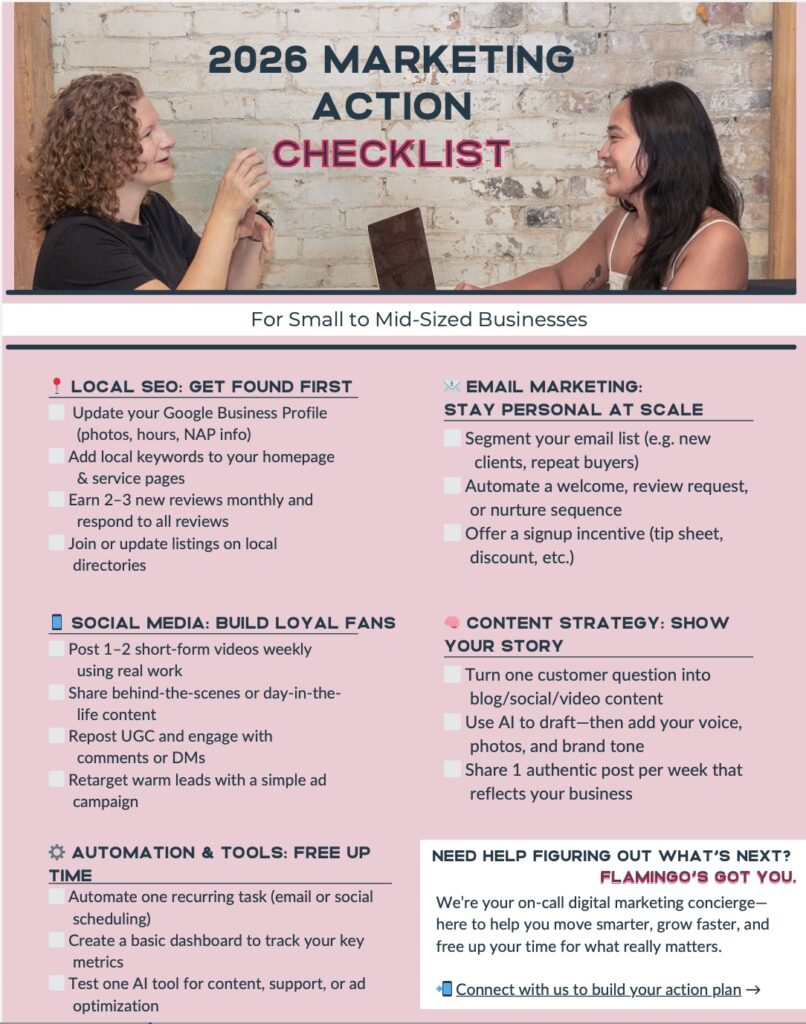
Marketing often takes a backseat to daily operations – but in 2026, ignoring it means missing out.Nearly 94% of small businesses planned to increase their marketing spend in 2024, and with the right moves, you don’t need a huge budget to stand out. Whether you’re a roofer, boutique owner, or painter in West Michigan, this guide highlights five realistic strategies to grow your business without burning out.
Get Found First: How to Win in Local Search in 2026
If your business serves a local market – like a Grand Rapids painter or a Kalamazoo roofer – mastering local search is non-negotiable. Google’s latest updates prioritize well-maintained listings, accurate local data, and user engagement. With AI-driven personalization influencing how results are shown, local SEO is evolving fast.
Focus your efforts on:
Optimizing your Google Business Profile with correct NAP info, updated photos, and hours.
Using location-specific keywords and content to improve how search engines connect you to local queries.
Encouraging and responding to reviews – these are increasingly factored into AI-generated search summaries.
Getting listed on local directories and trade associations to boost your digital footprint.
Add local keywords to your homepage and service pages
Set a goal to earn 2-3 new reviews per month
Join or update listings on relevant local directories
Respond to every review (positive or negative) within 48 hours
Build Loyal Fans, Not Just Followers: Social Media That Converts
Social media remains one of the best marketing avenues for small businesses – but the game has changed. The focus in 2026 is clear: prioritize community and visibility over virality. Platforms like Instagram, Facebook, and TikTok are evolving fast with AI tools that help you create content quickly while rewarding authentic, engaging posts with local reach. Sprout Social’s 2024 report confirms that users increasingly favor brands that foster community over those chasing trends.
The sweet spot? Short-form videos, behind-the-scenes clips, and user-generated content (UGC). Think a local painter sharing a 30-second time-lapse or a bakery showing off a frosting technique. Invite your happy customers to tag you and reshare their posts – real stories win trust.
Think connection over perfection. The businesses showing up and engaging daily are the ones building long-term brand loyalty.
To Do List:
Create 1–2 short-form videos each week using real customer work
Share behind-the-scenes or day-in-the-life content weekly
Encourage customers to tag you and repost their UGC
Run a low-budget ad campaign to retarget your warm leads
Set aside 15 minutes daily to engage with comments and DMs
Stay Personal at Scale: How Email Marketing Still Wins
Luckily, automation tools can help. Set up triggers like birthday discounts or follow-up messages without lifting a finger. Just remember – add a personal touch: use their name, location, or reference their last interaction. Keep it casual and helpful, not robotic.
The goal is for your emails to feel like a helpful nudge from a neighbor, not spam. When done right, email is not only great for nurturing leads – it’s also a powerful driver of repeat business.
And your list? That’s an asset you own. Promote signups with a freebie or discount – because unlike social media, no algorithm can take it from you.
To Do List:
Segment your email list and personalize your messages
Automate one new nurture or follow-up sequence
Promote your email list with an incentive to grow subscribers
Your Story Sells: Creating Authentic Content in the Age of AI
Content creation has changed – fast. Generative AI tools can now help you draft blogs, brainstorm ideas, and generate social captions in seconds. HubSpot’s 2024 State of Marketing report shows that over 60% of marketers are using AI to support content creation while balancing it with authenticity. But with this surge in automation, audiences are tuning in to what feels real. Templated content gets ignored. Your voice gets remembered.
Use AI to speed up drafting, but infuse it with your personality, real stories, and photos. That blend builds trust.
And don’t overcomplicate your content strategy. One great idea can stretch far: a common customer question becomes a blog, a short video, and a social post. For example, a landscaper might show a yard transformation with before-and-after photos, write a quick seasonal tip blog, and create a video walkthrough – all from one project.
Share what matters – how you help people, what problems you solve, and what your clients are saying. That’s what builds trust. Add in smart SEO practices, and your content can keep delivering long after it’s posted.
AI is a boost, not a replacement. Your story is still the reason people choose you.
To Do List:
Repurpose one customer question into 3 content formats
Use AI to generate first drafts, but add your voice and examples
Commit to one authentic content post per week that reflects your brand
Free Up Time and Get Clarity: Automation for Busy Owners
When you wear a million hats in your business, time is your most precious resource. This is where digital tools and automation come in – to take repetitive tasks off your plate and provide insights that used to require a whole analytics department.
Consider some examples of working smarter:
Scheduling and Automation: Use social media schedulers to batch your posts in advance, or email automation to send out drip campaigns and follow-ups without manual effort.
Customer Relationship Management (CRM): An entry-level CRM system will organize your customer contacts, track interactions, and even remind you when to follow up.
Analytics and Dashboards: Tools like Google Analytics, social media insights, and ad platform analytics show you what’s happening. Better yet, you can link data into one dashboard to see all your key metrics in one place.
AI for Efficiency: From AI writing assistants to tools that automatically adjust your ad bids, artificial intelligence is a small business’s new best friend. According to McKinsey, 40% of businesses using AI have already seen significant cost savings or revenue increases from adopting automation.
If you’re still manually juggling email follow-ups or guessing what’s working in your marketing, this is your sign to simplify. Small businesses in 2025 have an expanding toolkit to do just that. A few smart tools can free up your time and sharpen your strategy. You’ll look more polished, move faster, and stay competitive – even without a big team.
To Do List:
Automate one repetitive task using a scheduling or email tool
Set up a simple dashboard to track key marketing data
Choose one AI tool to test for writing, customer service, or ad optimization
Putting It All Together (And Getting Help If You Need It)
It’s clear that successful small business marketing today isn’t about out-spending the big players – it’s about out-thinking them with smart, customer-focused strategies. By honing your local SEO, engaging genuinely on social media, nurturing leads through email, sharing valuable content, and leveraging automation tools, you can create a marketing engine that punches well above its weight.
Feeling inspired but unsure where to start? You’re not alone. Every growth story begins with a decision to take that first step – and you’re already there just by reading this. That next step? Let’s talk about where your business is headed and how to use these trends to fuel your growth.
Connect with Flamingo Consulting to chat through what’s working, what’s not, and what could move the needle. We’ll help you make sense of what matters most and build a clear, customized action plan – without the stress. It’s time to get focused, get confident, and get moving. Want a simple way to start? Download our free checklist that recaps these key trends and gives you a quick-reference guide to take action – on your time.








Recent Comments